For decades, the economic relationship between the United States and Europe has been one of the most stable and interconnected in the world. Trade flowed relatively freely, supply chains stretched across the Atlantic, and cooperation was often framed as mutually beneficial.
But over the past few years, this balance has begun to shift.
While political rhetoric still emphasizes partnership, a quieter transformation is underway — one driven by tariffs, industrial policy, and strategic economic decisions.
At the center of this shift is a growing reliance by the United States on tariffs targeting key European industries.
📊 The Return of Tariffs in a Globalized World
Tariffs were once seen as outdated — a tool of the past in an increasingly globalized economy. For years, the dominant trend was toward trade liberalization, reduced barriers, and international cooperation.
However, the global landscape has changed.
Economic shocks, geopolitical tensions, and supply chain disruptions have led many countries to rethink their approach to trade. The United States, in particular, has moved toward a model that prioritizes domestic resilience over global efficiency.
Tariffs are now being used not just to protect industries, but to:
- influence global supply chains
- incentivize local production
- create strategic advantages in key sectors
This marks a significant shift in how economic policy is applied.
🏭 Which European Sectors Are Affected
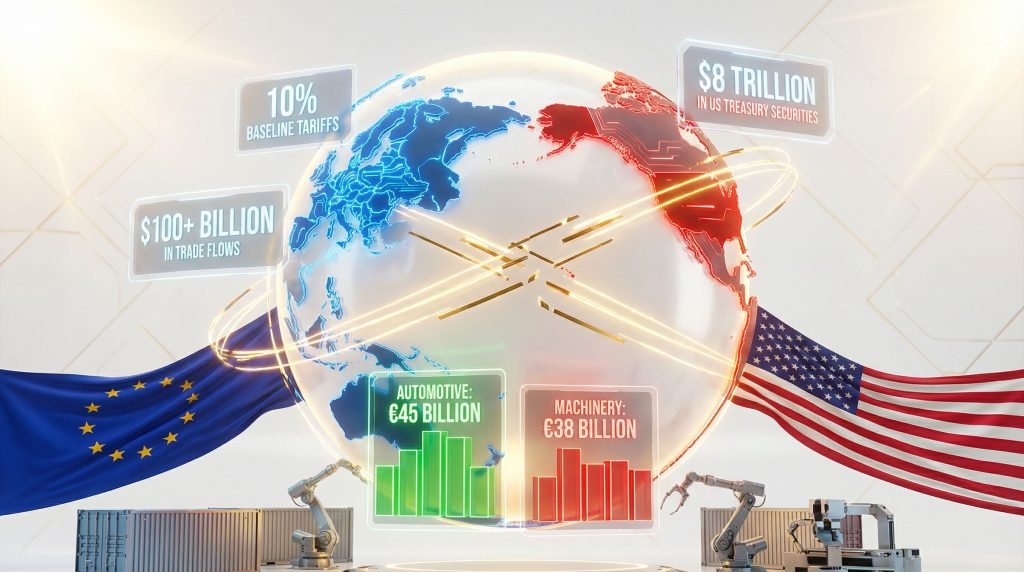
The impact of U.S. tariffs is not evenly distributed. Instead, it is highly targeted — focusing on sectors where Europe has traditionally been strong.
Among the most affected industries are:
- automotive manufacturing
- machinery and industrial equipment
- metals, including steel and aluminum
- renewable and green technologies
Countries such as Germany, France, and Italy play a central role in these sectors, making them particularly vulnerable to changes in U.S. trade policy.
For companies operating in these industries, tariffs introduce new challenges:
- increased export costs
- reduced price competitiveness
- tighter profit margins
- uncertainty in long-term planning
In some cases, businesses are forced to rethink entire strategies — including where they produce goods and which markets they prioritize.
⚡ Beyond Economics: A Strategic Power Move
To understand the full impact of tariffs, it’s important to look beyond economics.
From the U.S. perspective, tariffs are part of a broader strategy aimed at strengthening national industries and reducing reliance on external partners. This includes:
- bringing manufacturing back to domestic territory
- securing control over critical supply chains
- maintaining leadership in emerging technologies
In this context, tariffs become a tool of geopolitical influence.
They are used not only to protect markets, but to shape the global economic order.
💬 Europe’s Position: Balancing Response and Stability
Europe’s response to U.S. tariffs has been notably cautious.
Rather than escalating tensions through aggressive counter-tariffs, the European Union has largely focused on adaptation. This includes:
- investing in domestic industries
- strengthening internal markets
- diversifying trade relationships
There are several reasons for this approach.
First, Europe and the United States remain deeply interconnected. A full-scale trade conflict could have serious consequences for both sides.
Second, Europe faces its own internal challenges — from economic disparities between member states to the need for large-scale industrial transformation.
As a result, the strategy has been to adjust gradually rather than react aggressively.
🌍 A Fragmenting Global Economy
The rise of tariffs between major economic powers reflects a broader transformation in the global economy.
The model of globalization that dominated the late 20th and early 21st centuries is evolving.
Instead of fully open markets, we are seeing:
- the formation of regional economic blocs
- increased emphasis on economic sovereignty
- a shift toward localized production
This does not mean global trade is disappearing — but it is becoming more structured, more strategic, and in some cases, more restrictive.
🔍 The Ripple Effects on Businesses and Consumers
Although tariffs are implemented at the policy level, their effects extend far beyond governments and large corporations.
For businesses, especially exporters, tariffs can lead to:
- reduced access to key markets
- increased operational costs
- pressure to relocate production
For consumers, the impact may be less immediate but still significant:
- higher prices for imported goods
- reduced product availability
- slower innovation in certain sectors
Over time, these changes can reshape entire industries.
📉 Long-Term Implications for Europe
If current trends continue, Europe may face several long-term challenges:
- Reduced export competitiveness
European companies may struggle to maintain their position in the U.S. market. - Pressure to localize production
More businesses may shift operations closer to target markets. - Increased economic independence — at a cost
While reduced reliance on external partners can increase resilience, it may also reduce efficiency. - The need for structural reform
Europe may need to accelerate innovation and industrial policy to remain competitive.
❓ What Comes Next?
The key question is whether this shift is temporary or part of a long-term transformation.
If tariffs remain a central tool of economic policy, we could see:
- a permanent restructuring of global trade relationships
- reduced interdependence between major economies
- the emergence of new financial and industrial models
For Europe, this means adapting to a world where traditional assumptions about trade no longer apply.
🔥 Conclusion
U.S. tariffs on European goods are not just a technical policy measure.
They are part of a broader shift in how economic power is exercised in the modern world.
As global dynamics continue to evolve,
the ability to adapt — quickly and strategically — will define which economies thrive and which fall behind.
👉 Final Thought
What appears today as a gradual policy adjustment
may, in hindsight, be recognized as a turning point in global economic history.